Tagged: warranty-of-habitability
Legal Liability and Invasive Knotweed in the United States – Part 2 of 3
The most recent case concerning invasive knotweed was just decided by the Massachusetts Appeals Court, Trites v. Cricones, Slip Op No. 23-P-884 (Mass App Ct 2025). In this case, the homeowners, the Trites, brought an action against the developer and seller, Cricones and his company Reedy Meadow, LLC. The Trites claimed that Cricones and Reedy Meadows failed to disclose the presence of invasive knotweed (as well as glass and other debris mixed in with the soil) on the purchased property. The trial court found the defendants engaged in unfair and deceptive practice under the Massachusetts Consumer Protection Act , chapter 93A. The trial court awarded the Trites $186,000 in damages and added reasonable attorney’s fees. The Appeals Court affirmed the judgment.

According to the Massachusetts Appeals Court the plaintiffs, the Trites, had to show under chapter 93A:
- the defendants knew hazardous material contaminated the property;
- the defendant did not disclose the contamination; and
- the plaintiff would not have purchased the property had the plaintiff known of the contamination.
As to whether Cricones knew about the contamination, the court identified several facts. Before the sale, Cricones had spread topsoil in the housing development, even though he knew the soil was contaminated with invasive knotweed. In addition, he had been warned by a subcontractor not to use the contaminated loam because it contained viable invasive knotweed plant parts.
Cricones also did not disclose the contamination to the Trites. Finally, the Appeals Court found that it was “clear that the Trites would not have purchased the property had they known about the contamination of its soil.” If the plaintiff knew about the contamination before the purchase, the defendants could have avoided liability. As the court observed, however, the Trites “bought the house before the knotweed growing season began, and snow and hydroseed prevented them and their inspector from detecting contaminants in the soil before purchase.” The court therefore affirmed the trial court ruling on chapter 93A liability.
The Rest of the U.S. – Invasive knotweed and Its Effect on Real Estate Transactions
How does the Trites case fit within the nationwide landscape of residential real estate law? It is important to remember that Trites was decided under a state consumer law. The outcome could be different in other states which do not have consumer laws that are as far-reaching as Massachusetts.
In most states, the laws which govern home sales are a combination of judge made law (the “common law”) and statutory law. The legal doctrines which govern home sales broadly fit within the four categories discussed below.
1. Warranty of Habitability. This warranty can have its origin in statute, the common law, or a combination of the two. Some states may require the seller to include the warranty in the sales contract. The warranty typically only applies to new homes.
In its purest form, the warranty of habitability imposes strict liability. There is no question of whether the defect in question is obvious or hidden. There is also no question about the seller’s or the buyer’s awareness of any defects.
New Jersey was the first state to adopt a strict liability standard via a court decision. See Schipper v. Levitt and Sons, Inc., 44 N.J. 70 207 A.2d 314 (1965). California now has common law and statutory protections that make builders of new homes strictly liable for certain construction defects. See Kriegler v. Eichler Homes, Inc., 269 Cal. App. 2d 224, 227 (1969). California Right to Repair Act, Civil Code §§ 895 – 945.
This warranty holds the seller responsible for any “material defect” in the property sold. It appears that every state, no matter which of the four doctrines the state has adopted, requires for a defect to be “material,” for it to be actionable.
With regard to what is a “material defect,” there are really two questions:
- What is a defect? Or, what kinds of defects are considered?
- What it material?
What kinds of defects are considered? According to the International Association of Home Inspectors Standards of Practice for Performing a General Home Inspection (revised October 2022), Standard 1.2 a material defect “is a specific issue with a system or component of a residential property that may have a significant, adverse impact on the value of the property, or that poses an unreasonable risk to people.”
Is the green space that the invasive knotweed infests considered “a system or component of residential property”? Under the international standard, it doesn’t seem to be. “Systems” and “components” are all connected with physical structures: roof, exterior, basement, heating, cooling, plumbing, etc. The inspector is supposed to inspect “vegetation, surface drainage, retaining walls and grading of the property, where they may adversely affect the structure due to moisture intrusion.” Section 3.2,I.I. However, the inspector does not have to “inspect or identify geological, geotechnical, hydrological or soil conditions.” 3.2, IV.C.
One law review article also suggests that, at least with the warranty of habitability, the protection does not extend beyond the physical structures and its systems. Shisler RH, Caveat Emptor Is Alive And Well And Living In New Jersey: A New Disclosure Statue Inadequately Protects Residential Buyers, 8 Fordham Environ Law Rev, 181, 192-193 (1996).
Assuming that a defect does extend to defects beyond those in the physical structures, what makes a defect “material”? Generally, a fact is material if a reasonable person would attach “importance” to its existence or nonexistence in choosing a course of action in the transaction in question. Restatement (Second) of Torts § 538 (1989). The International Building Code says a defect has to have a “significant, adverse impact” on the property value. Massachusetts, as noted above, seems to have an even higher standard for “materiality.” Massachusetts under chapter 93A required a showing “the plaintiff would not have purchased the property had the plaintiff known of the contamination.” Trites, Slip op at 16. In short, there is no generally accepted definition of what a material defect is with regard to real estate.
To show a knotweed infestation was a material defect, plaintiffs can submit proof such as the following:
- the buyer’s use and enjoyment of green space – recreating, gardening, landscaping would be or was affected;
- the effect of invasive knotweed on property values (likely expert testimony); and
- the effect (actual or potential) of invasive knotweed on physical structures (likely expert testimony).
Defendants can argue that the presence of invasive knotweed is not a “material defect.” They could point to the fact that home inspectors are not required to look for it. This fact alone may suggest non-materiality. After all, inspectors should inspect for things that are important to homeowners.
How long does the warranty of habitability last? In some states, like Illinois, this warranty is a common law doctrine, and the warranty has no specific duration. Illinois courts generally require that defects be reported within a “reasonable time” after discovery. In Arizona, it appears to last at maximum, eight years. Zambrano v. M & RC II, LLC, 254 Ariz. 53 (2022). Warranties may be limited to the original purchasers of new homes. Dallon, “Theories of Real Estate Broker Liability and the Effect of the “As Is” Clause, 54 Florida Law Rev 2002, 395, 408 note 66. However, as Zambrano makes clear, that is not the case in Arizona.
2. Disclosure of Known Defects. Most states require a disclosure of known “defects.” This doctrine often applies regardless whether the transaction involves new or old construction or a professional builder. One example is Minnesota law, Minn. Stat. Sec 513.55 (2024). Minnesota law requires the seller to identify “all material facts of which the seller is aware that could adversely and significantly affect: (1) an ordinary buyer’s use and enjoyment of the property; or, (2) any intended use of the property of which the seller is aware.” Note that this standard requires the disclosure of both patent (i.e., “obvious”) and latent (i.e., hidden) defects. Interestingly, this Minnesota law does not on its face look to the effect of the defect on “property values” but instead looks at “use and enjoyment of the property” by the purchaser. Here plaintiffs might have to argue that the invasive knotweed affected their “use and enjoyment of the property” in at least two ways: first, it required them to work or pay for work to control the knotweed; second, it affected their “use and enjoyment” because the knotweed depreciated property value and potentially made the property harder to sell.
“all material facts of which the seller is aware that could adversely and significantly affect: (1) an ordinary buyer’s use and enjoyment of the property; or, (2) any intended use of the property of which the seller is aware.”
Minnesota Statute Section 513.55 (2024).
In at least two respects, the duty to disclose “known defects” may be broader than the warranty of habitability. First, it applies to both new and used homes. This is important since new home sales made up only 30% of home sales in 2024 in the U.S.
Second, the requirement to disclose “known defects,” unlike the warranty of habitability, may extend beyond just the physical structures. There is not much reported case law on this. However, such defects may be actionable under the duty to disclose known defects. Shisler RH, Caveat Emptor Is Alive And Well And Living In New Jersey: A New Disclosure Statue Inadequately Protects Residential Buyers, 8 Fordham Environ Law Rev, 181, 192-193 (1996).
3. Disclosure of “Latent” or “Hidden” Defects. Some states only require the disclosure of hidden defects. A hidden defect is “one which could not be discovered by reasonable and customary observation or inspection.” Cornell Law School, Legal Information Institute, “Latent Defect” (Updated June 2020). For example, in Maryland even if a seller and buyer agree to an “as is” sale of real property, the seller still must disclose latent defects the seller is aware of.
With invasive knotweed, this doctrine raises all sorts of questions. In Trites, the plaintiff were not required to prove the defects were hidden. Nonetheless, the plaintiffs offered proof that they were: The inspector testified that it was not customary to inspect for invasive knotweed, and so the inspector did not inspect for it. Moreover, the inspection was conducted in winter after the lawn had been hydroseeded. Both of these hid the presence of the knotweed.
What if the invasive knotweed was growing in plain sight? Under normal circumstances a defect that is visible would be “patent” or “obvious.” However, an argument could be made that, because invasive knotweed is not well-recognized hazard in the U.S., the presence of it is not a defect which could be “discovered by reasonable and customary observation or inspection.”
4. Caveat Emptor or “Buyer Beware.” Some states do not require any disclosures in home sales (other than federally mandated ones). Interestingly, Massachusetts, the state in which the Trites case arose, is one of these. In these states a private, non-commercial seller would not have to make any disclosure related to invasive knotweed. Thus, in Massachusetts a seller was not held liable even though the seller knew the house was infested with termites. Swinton v. Whitinsville Savings Bank, 311 Mass. 677, 42 N.E.2d 808 (Mass. 1942). A critical reason why caveat emptor did not apply in Trites was that Cricones’s development company, Reedy Meadow, LLC, had to comply with the state’s consumer laws and was also sued. If the Trites had bought their house from a private party not in the real estate business, the Trites likely would not have prevailed.
There is an exception to caveat emptor. If a seller actively conceals a defect, this can constitute fraud which is a known exception to caveat emptor. This concealment has to be more than mere silence. In one New York case, for example, the seller was found to face potential liability because the seller allegedly covered rotted wood with new wood to hide areas where water infiltrated. Striplin v. AC&E Home Inspection Corp., 2023 N.Y. Slip Op. 03720 (2d Dept. July 5, 2023).
In Trites there was no proof of fraud. However, the line between active concealment and just spiffing up the property could be a fine one. For example, if a seller has knotweed on the property and cuts it down and covers the location with mulch and maybe plants some ornamental plants, is this “active concealment”?
Advice to Home Buyers and Sellers
Ultimately, advice to home sellers can be boiled down to this. First, control the invasive knotweed. Even if the knotweed cannot be fully eradicated before sale, a site with scattered small knotweed plants is far different from a dense patch with twelve-foot-tall aerial shoots.
Second, disclosure of a knotweed infestation goes a long way toward reducing your potential liability. If Cricones had indicated to the Trites that there was knotweed on the property, he and his company would have prevailed. Even in states with the strictest liability, a full disclosure may absolve a seller of potential liability. After all, if a buyer buys a home knowing the lot has invasive knotweed on it, the buyer would have more difficulty claiming the knotweed on the property was a material defect. The decrease in value caused by the knotweed patch was presumably incorporated in the sales price (or was so immaterial that the presence of knotweed didn’t affect the price).
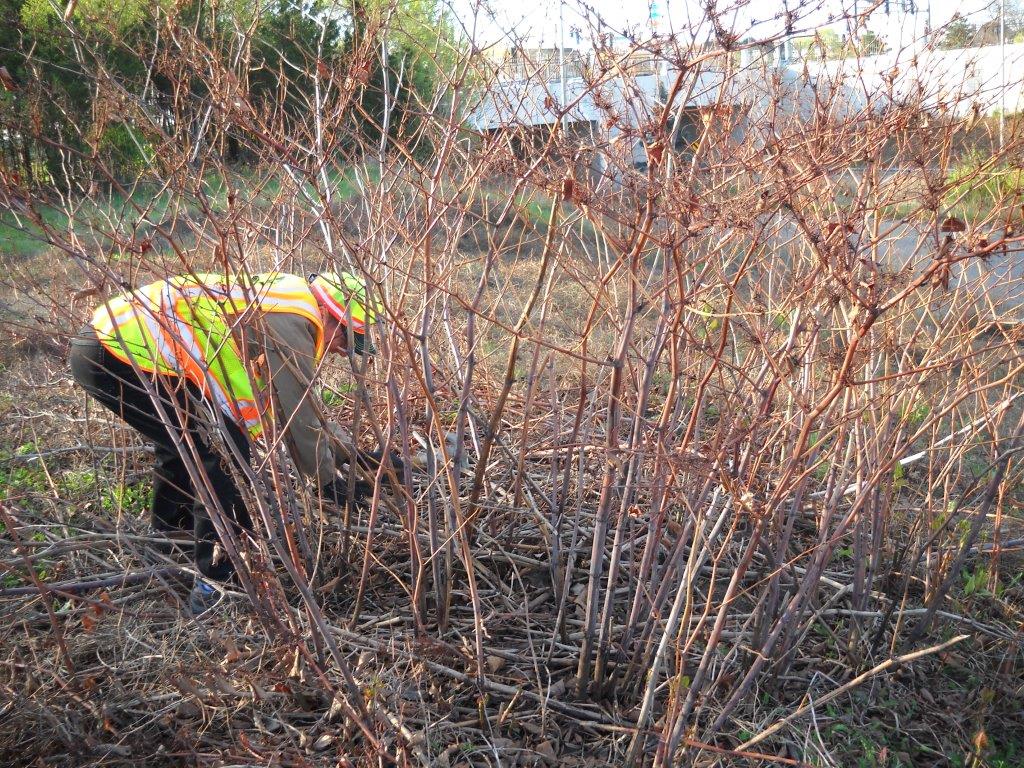
If you are a buyer, especially in an area with heavy knotweed infestations, you should ask the seller about any invasive knotweed. This would be especially important on a large piece of property that cannot be thoroughly inspected. Be aware, however, that many sellers may legitimately not know what it is. Ask your attorney about getting written assurances. Regardless, you or someone you hire should inspect the property. If it’s winter, look for the tell-tale reddish colored stems.
 Green Shoots News